The SAVEDpreneur™ Spotlight: Dr. Stefanie Bennett, PhD., Psychologist
From a young age, I knew I was here to be what I call a “soul doctor”: someone who helps others heal at the deepest level of their being. The vision was always rooted in restoring the soul through a moral and spiritual framework, grounded in Christ-centered consciousness.

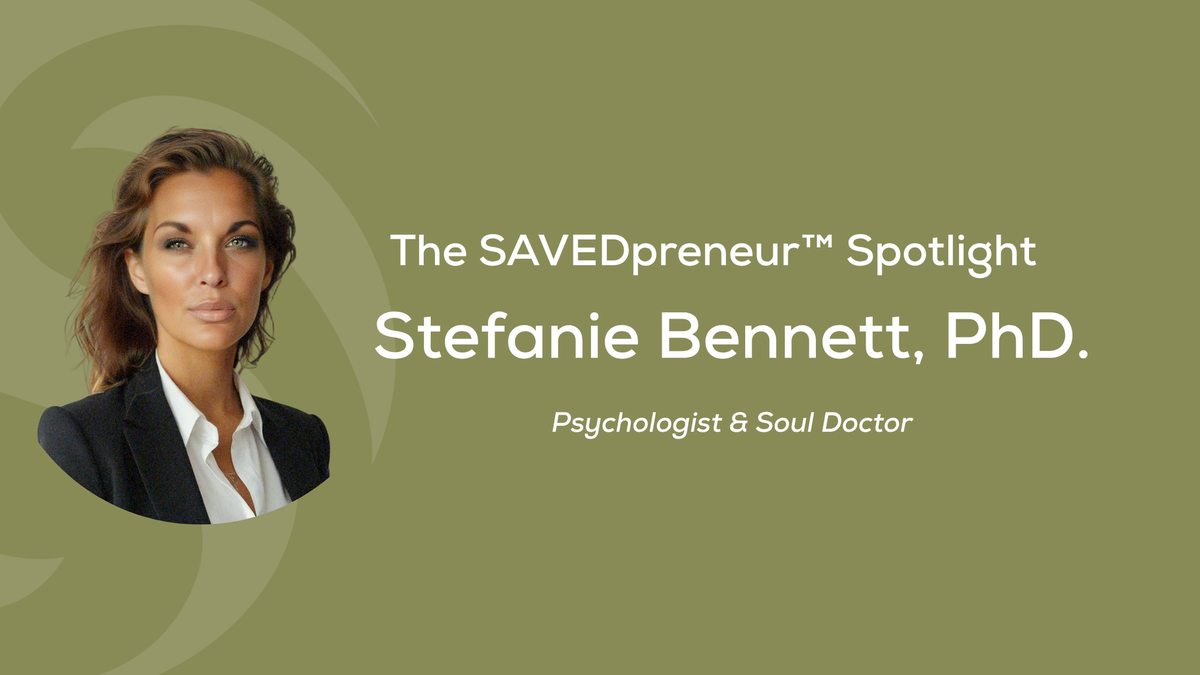
Dr. Stefanie Bennett, Ph.D. has been called a “soul doctor” since before she had a practice, a title, or a framework to put around it. When life forced her to confront herself at every level, emotionally, psychologically, and spiritually, she discovered that her pain was not just personal. It was purposeful. Today she helps others heal at the deepest level of their being, bridging spiritual anthropology with psychological healing and building toward an educational center rooted in Christ-centered consciousness. She is not fixing what is broken. She is helping people reclaim what was always whole.
Let's lean in.
Tell us who you are and when did you know God was calling you to do more and be more?
I am Dr. Stefanie Bennett, and my work sits at the intersection of spiritual psychology, soul healing, and sovereignty. My calling became undeniable during a series of deeply challenging life experiences that forced me to confront fragmentation at every level: emotional, psychological, and spiritual. In those moments, I realized I was not just meant to heal. I was meant to help others rise. What I walked through became the foundation for the work I now offer.
What was your first encounter with God and how did you know you were saved?
At 16, I had a direct encounter with Christ that shifted the trajectory of my life. It was not conceptual. It was deeply experiential. There was a clarity, a presence, and a knowing that stayed with me. I did not have language for it at the time, but I knew I had touched something real, something eternal, and that it had claimed me as much as I had claimed it.
Many of us want to be successful. What does success mean to you?
Success, to me, is helping people in a way that is real, practical, and transformative. Not abstract inspiration, but grounded, applicable change. If someone can walk away from my work feeling more clear, more sovereign, and more connected to their truth, that is success.
When God gave you a vision for your life and work, what did it look like? Are you working to fulfill it? How?
From a young age, I knew I was here to be what I call a “soul doctor”: someone who helps others heal at the deepest level of their being. The vision was always rooted in restoring the soul through a moral and spiritual framework, grounded in Christ-centered consciousness.
Over time, that vision expanded into the idea of an educational center, a place where people could come to understand the deeper architecture of their suffering and reclaim their inner freedom. It took years to build the courage to pursue it, and along the way, I had to release relationships and paths that no longer aligned.
Today, I am actively fulfilling that vision through my writing, my private work with clients, and the development of frameworks that bridge spiritual anthropology with psychological healing. My upcoming book on the spiritual anatomy of psychological illness is a core part of that mission.
Healing is not about fixing what is broken. It is about reclaiming what was always whole beneath the fragmentation.
What does being a SAVEDpreneur™ mean to you? What is your kingdom assignment and how are you carrying out your assignment now?
To me, being a SAVEDpreneur means that the business is the ministry — there's no separation between the two. The Sophia Institute isn't a vehicle I use to fund my real work. It is the real work.
Being a SAVEDpreneur means I've stopped apologizing for building something that takes the soul seriously in a marketplace that mostly doesn't, and I've stopped waiting for institutional permission to do it. It means the P&L and the prayer life are in conversation with each other. It means every program I design, every client I serve, every book I write is an act of consecration. The business exists because God needed a structure through which this healing could move — and I said yes to being that structure.
What did God call you to build, and how did you know? What steps did you take to be obedient? How quickly did it take you to answer the call?
I was called to build a home for the soul — a place where people who had been spiritually and psychologically dismembered by narcissistic abuse could find their way back to themselves. I knew because the knowing came the way all real vocational knowing does: not as a plan, but as an impossibility I couldn't stop moving toward. I had spent nearly two decades sitting with women whose deepest wound wasn't behavioral — it was ontological. They had been convinced they had no self worth returning to. That lie had to be answered. The Sophia Institute is my answer.
Obedience looked like leaving behind the security of conventional clinical frameworks, trusting that soul-level healing was not only valid but necessary, and building the language, the methodology, and the container for it — even before the world had a category for what I was doing.
Where did obedience cost you something—money, time, identity, approval? And how did you handle the tension?
t cost me all of those things, honestly — and in that order. There were years of building without income that matched the depth of the work. There was the professional risk of naming Anthroposophy, Sophia, and the Magdalene tradition in clinical spaces that still flinch at the word soul. The approval cost was real: stepping outside the boundaries of credentialed psychology to say that trauma is a spiritual event, not just a neurological one, means you live in the margins of both worlds for a while. I handled the tension the way I teach my clients to — by returning, again and again, to what I call the Inner Throne. Not certainty. Not applause. Just the uncolonizable place in me that knew what it was building and why.
What is the best way for our readers to keep up with you?
Website: drstefaniebennett.com
Instagram: @drstefaniebennett
Facebook: @drstefaniebennett
Threads: @drstefaniebennett
Books on Amazon: search Dr. Stefanie Bennett